Search Stories
Find stories by title, author, category, or keywords
The Voyage of the Portland — A Family's Journey to a New World
On 24 July 1837, Robert and Margaret Murray boarded the barque Portland at Greenock, Scotland, with their two young children — Marion, aged 3, and baby Daniel, just 6 months old. They were among 310 emigrants fleeing a devastating Highland famine, their passage arranged by the remarkable Rev. Dr. John Dunmore Lang as part of a government-assisted emigration scheme. Each adult received a bounty of 15 pounds; the children 5 pounds between them.
The 133-day voyage to Sydney was a harrowing ordeal. Soon after leaving Greenock, a measles epidemic swept through the ship, killing 25 of the younger children. Then, crossing the tropics, scurvy broke out — gums turned tender, muscles ached, and passengers grew desperately ill. Dr. Lang ordered an emergency stop near Cape Leeuwin, Western Australia. At Albany, the worst cases were brought ashore; holes were dug in the ground and patients placed their legs in the earth up to the knees. Within days, all had recovered.
The Portland finally reached Sydney on 3 December 1837. The colony's white population was just 16,000. The Murray family had survived one of the most difficult voyages of the era, and would go on to help build a new nation — eventually making their way to Melbourne, then to the Castlemaine goldfields, where their daughter Marion would meet and marry Nicholas Webber in 1857.
More Family Stories
Explore memories and moments from across our family history
Gold, Poverty and a New Life — The Webbers Come to Australia
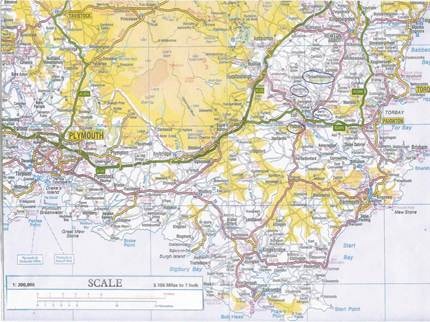
In 1852, Jane Cole/Webber boarded the ship Persian with her two children — Nicholas (17) and Elizabeth (15) — leaving behind the poverty of Broadhempston, Devon, for the promise of gold in Victoria. The Webber name itself told their story: in Devon dialect, a Webber was a wool weaver, and generations of the family had worked the wool trade in the villages of Broadhempston, Staverton and Berry Pomeroy. But by 1852, poverty had made the decision for them. Nicholas would go on to work the Castlemaine goldfields, obtain his Miner's Right in 1857 (now held by the Castlemaine Historical Society), and marry Marion Murray — the daughter of Scottish immigrants who had made the same brave journey fifteen years earlier.
Life in a Tent at Moonlight Flat
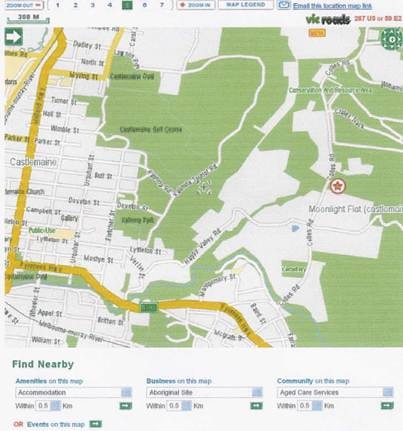
Nicholas and Marion Webber began their married life in a canvas tent at Moonlight Flat, Castlemaine — one of the world's richest alluvial goldfields. Their first three children were born in that tent. A murder occurred 60–70 yards away. Dysentery killed their third child at age one. Yet Nicholas found time to read 'The Natural History of Man' and inscribe it: 'N Webber, Moonlight Flat, Castlemaine 1860.'
Via Fiji to Melbourne — James Robertson's Remarkable Journey
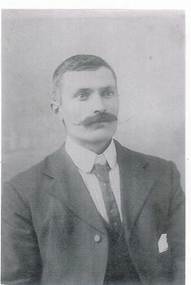
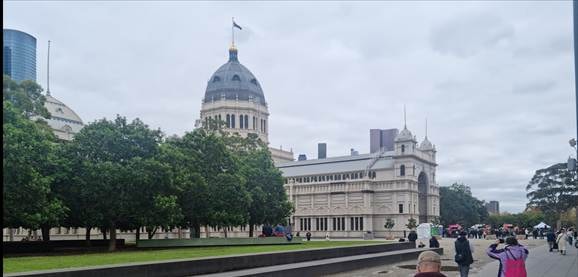
In 1878, James Lillie Robertson left Peterhead, Scotland — a whaling town 50km north of Aberdeen — and somehow ended up in Fiji before arriving in Melbourne on 1 February 1879 as the sole steerage passenger on the S.S. Suva. Nobody knows how he got to Fiji. He found work with Anderson's Engineering Co., then helped build the dome of Melbourne's Royal Exhibition Building — 68 metres high, completed in 1880. On 23 October 1880 he walked through the gates of Thompson's Foundry in Castlemaine and began a 45-year career that would make him the foundry's leading foreman. His wife Mary and five children followed in 1881 on the S.S. Norfolk, and the family built their home 'Inverugie' in Castlemaine — named after a village near Peterhead.
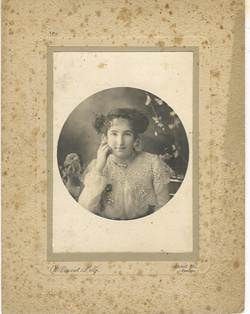
Winnie Bradbury — Melbourne's Forgotten Soprano
Winifred Alice (Winnie) Bradbury was born in Collingwood in 1887, the granddaughter of Nicholas and Marion Webber. A music teacher from Bendigo, she was appointed leading soprano at Scots Church, Melbourne in December 1910 — beating 13 applicants for a position paying 25 pounds per annum. She sang Handel's Messiah at Christmas 1911, performed Elgar's 'The Kingdom' at the Melbourne Town Hall in 1915 to a hall 'crowded to the doors', and was a member of the Royal Melbourne Philharmonic Society. She sang at Scots Church for over nine years. On Easter Sunday 1920 she sang 'I Know That My Redeemer Liveth' — her last performance. She died suddenly of diphtheria on 9 April 1920 at age 32. Her colleague Elsye Collier's tribute read simply: 'Parted, Elsye.' Her uncle Benjamin Arthur Webber wrote to his sister Bella: 'it was a sad affair and so sudden, a terrible thing.'
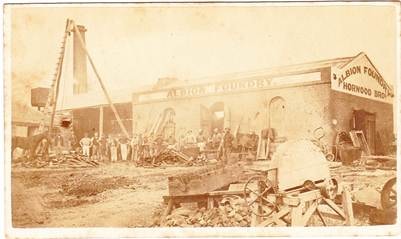
Alfred Webber — Found Drowned in the Yarra, 1888
Alfred Ernest Webber was born in 1867 at The Loddon, the seventh child of Nicholas and Marion Webber. He trained as a moulder at Thompson & Co. in Castlemaine, then moved to Melbourne to work at Langland's Foundry in South Melbourne — the city's oldest foundry, established in 1842. On 11 April 1888, aged 20, he shook hands with the servant girl Amy Edwards and said 'Good bye: I will find a watery grave.' She thought he was joking. He was found drowned in the Yarra River near the Falls Bridge on 16 April 1888, after being missing for six days. An inquest returned an open verdict. His mother Marion travelled to Melbourne to bring his body home to Castlemaine by train. His younger brother Benjamin Arthur was 15 years old.
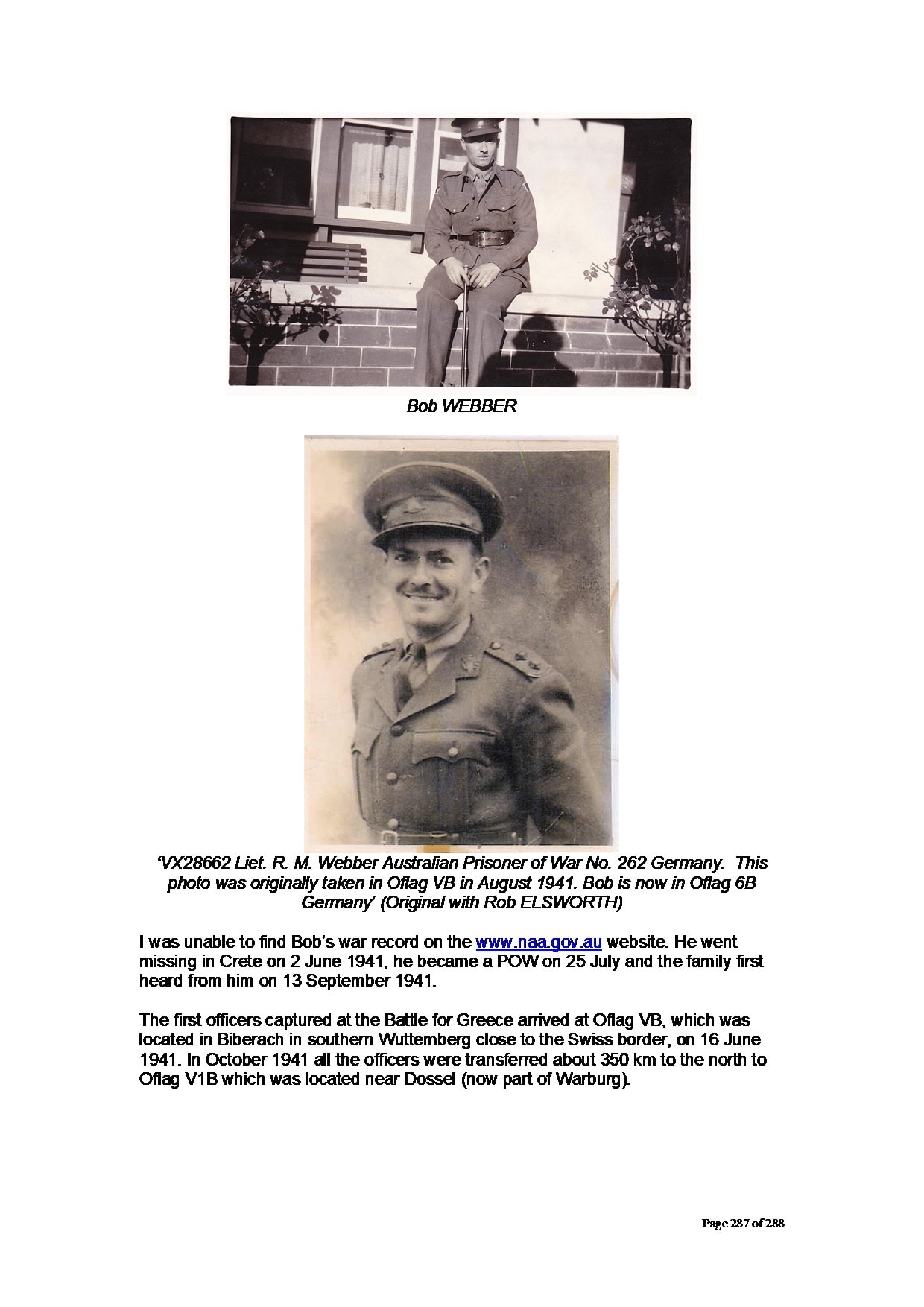
Bob Webber — Four Years in a German POW Camp
Robert Mace (Bob) Webber was born in Castlemaine in 1909, the sixth child of Benjamin Arthur and Jessie Webber. He completed his engineering apprenticeship at Thompson's Foundry in 1929, and by 1938 was a toolmaker at Victoria Barracks, Melbourne. He went missing in Crete on 2 June 1941. The family first heard from him on 13 September 1941 — he was Prisoner of War No. 262 at Oflag VB in Biberach, southern Germany, near the Swiss border. In October 1941 all officers were transferred 350km north to Oflag VIB near Warburg. He spent four years in German captivity. On 25 July 1945 the Melbourne Herald ran a photograph of his homecoming at Spencer Street Station, his family holding a 'WELCOME' banner — his sister Marion waving on the left, Lil behind the 'O'.
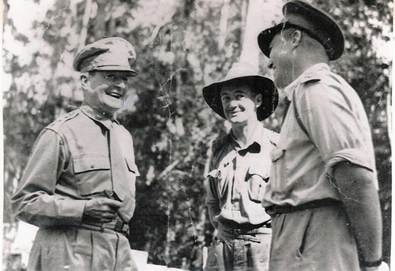
Nick Walsh at Kokoda — Photographed with General MacArthur
Nicholas David (Nick) Walsh was born in 1915, the son of Mary Lillie Robertson (daughter of James Lillie Robertson) and David Walsh. He served in WW2 in the Middle East and New Guinea. On 3 October 1942 — almost certainly the first day General MacArthur set foot in New Guinea — Nick was photographed with MacArthur at Ower's Corner, the exact spot at the start of the Golden Staircase of 2,000 steps on the Kokoda Track. His platoon fought the entire Kokoda Track to Soputa, finishing in January 1943 with only three men left from his original 25. He later wrote 'Kokoda Track 1942', published in 2010. He died in Brighton on 21 January 2016 at age 100 — the last of the Robertson cousins to pass away.
The Voyage of the Portland — A Family's Journey to a New World
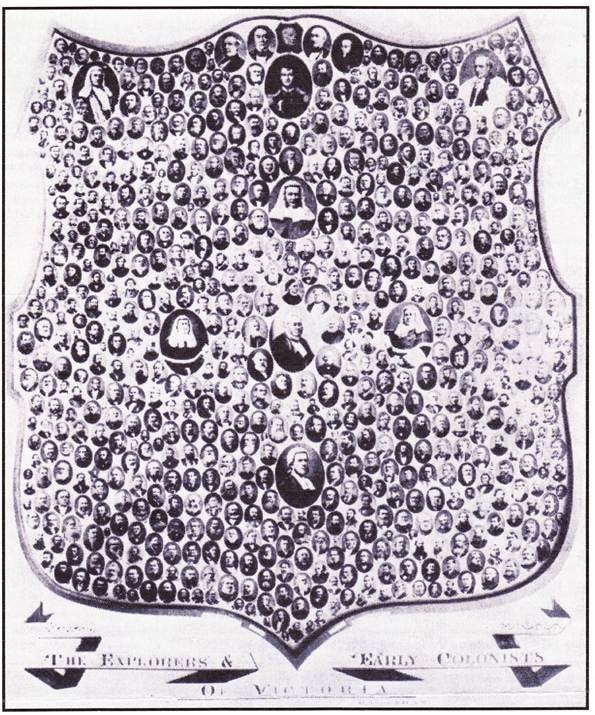
On 24 July 1837, the 541-ton barque Portland left Greenock, Scotland, carrying 310 emigrants chartered by the Rev. Dr. John Dunmore Lang. Among them were Robert and Margaret Murray — a Glasgow cabinet maker and his wife — with their two small children Marion (3) and Daniel (6 months). The 133-day voyage was harrowing: a measles epidemic killed 25 children; scurvy broke out crossing the tropics; an emergency stop at Albany, Western Australia saw patients buried leg-deep in the earth to recover. The ship reached Sydney on 3 December 1837. Robert Murray was later included in Thomas Foster Chuck's 1872 photo mosaic 'The Explorers and Early Colonists of Victoria' — one of just over 700 people depicted, the original held in a crate at the State Library of Victoria.
Harold Freedman — Victoria's State Artist and the Murals That Shaped Melbourne
Harold Freedman was born in Caulfield in 1915 and studied at Melbourne Technical College from 1929 to 1935. He married Lilian Mary Walsh — granddaughter of James Lillie Robertson — after World War 2, during which he served as a war artist with the RAAF Historical War Records Section in Borneo and Noemfoor. In 1972 Harold was appointed the State Artist of Victoria — a unique position with no previous or subsequent appointment. His major public murals included the Cavalcade of Transport at Spencer Street Station (1978), the History of Flight at Melbourne Airport (1971), the History of Australian Military Aviation at the Australian War Memorial (1972), the Legend of Fire mosaic at Eastern Hill Fire Brigade (1982), and the VFL Legends Mural at Waverley Park (1986). Harold Freedman died in 1999.
Thompson's Foundry — 180 Years of Robertson Service
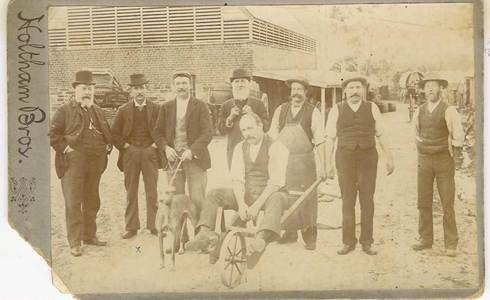
When James Lillie Robertson walked through the gates of Thompson's Foundry in Castlemaine on 23 October 1880, he began a family connection that would last eight decades. James himself worked there for 45 years, rising to leading foreman. In total, 11 members of the Robertson family worked at Thompson's Foundry for a combined 180 years. The foundry made everything from mining equipment to railway components, and the Robertson name became synonymous with its skilled workforce. James was also an elder of the Presbyterian Church and a life-governor of the Castlemaine Hospital — a man who built not just metal, but community.
BA Webber's Brighton Hotel — Twenty Years Behind the Bar
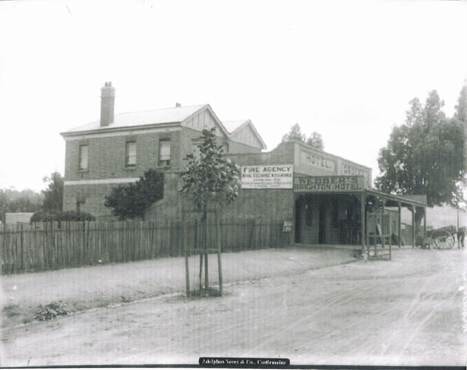
Benjamin Arthur Webber obtained his first hotel licence for the Brighton Hotel, Castlemaine in 1893. He ran it for over twenty years, becoming one of Castlemaine's best-known publicans. The hotel's business card read simply 'B.A. Webber, Brighton Hotel, Castlemaine.' He also ran the Webber Stores on Barker Street. In 1899 he married Jessie Ann Robertson — daughter of James Lillie Robertson — uniting the two families. The hotel was a social hub of Castlemaine life; BA's letters to his sister Bella Agel in Nottingham, written between 1911 and 1920, give a vivid picture of small-town Victoria: cricket scores, the price of hay, the death of Winnie Bradbury, and the anxious wait for news of Bob Webber in Crete.
Mary Webber and the DAP — A Wartime Farewell
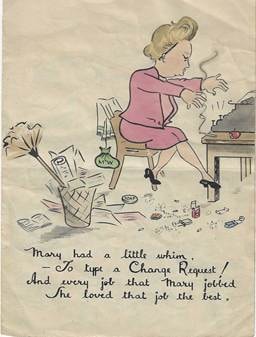
Mary Lillie Webber — daughter of Benjamin Arthur and Jessie Webber — worked at the Department of Air Production (DAP) during World War 2. When she left in 1946, her colleagues gave her a farewell card covered in signatures, a cartoon of her cooking in a messy kitchen, and a formal farewell notice in the Castlemaine Mail. The cartoon caption read: 'Mary in her new role.' She was also a keen hiker — a newspaper clipping shows her group running the 'Mystery Express' hike, and another records a women's farewell at Brighton Baths. Her hiking group called themselves the 'All Stars.' She later became a devoted member of the Presbyterian Church, and the memorial altar rail at the church was dedicated in her memory.
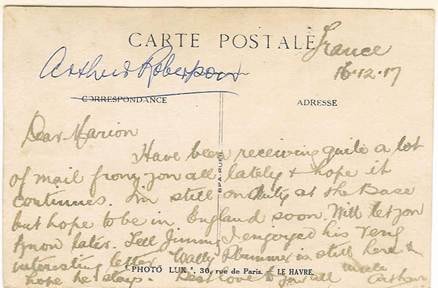
Arthur Robertson at Le Havre — A Postcard from the Western Front
Arthur Robertson — son of James Lillie Robertson — served in World War 1 and sent a postcard home from Le Havre, France in 1917. The postcard, still held by the family, shows the port city and carries a brief handwritten message. Arthur was one of several Robertson family members who served in both World Wars. His brother James also served. The Robertson family's military service spanned both wars: Arthur and James in WW1, Bob Webber (nephew by marriage) and Nick Walsh (great-nephew) in WW2. Nick Walsh's platoon on the Kokoda Track was reduced from 25 men to 3 by January 1943.
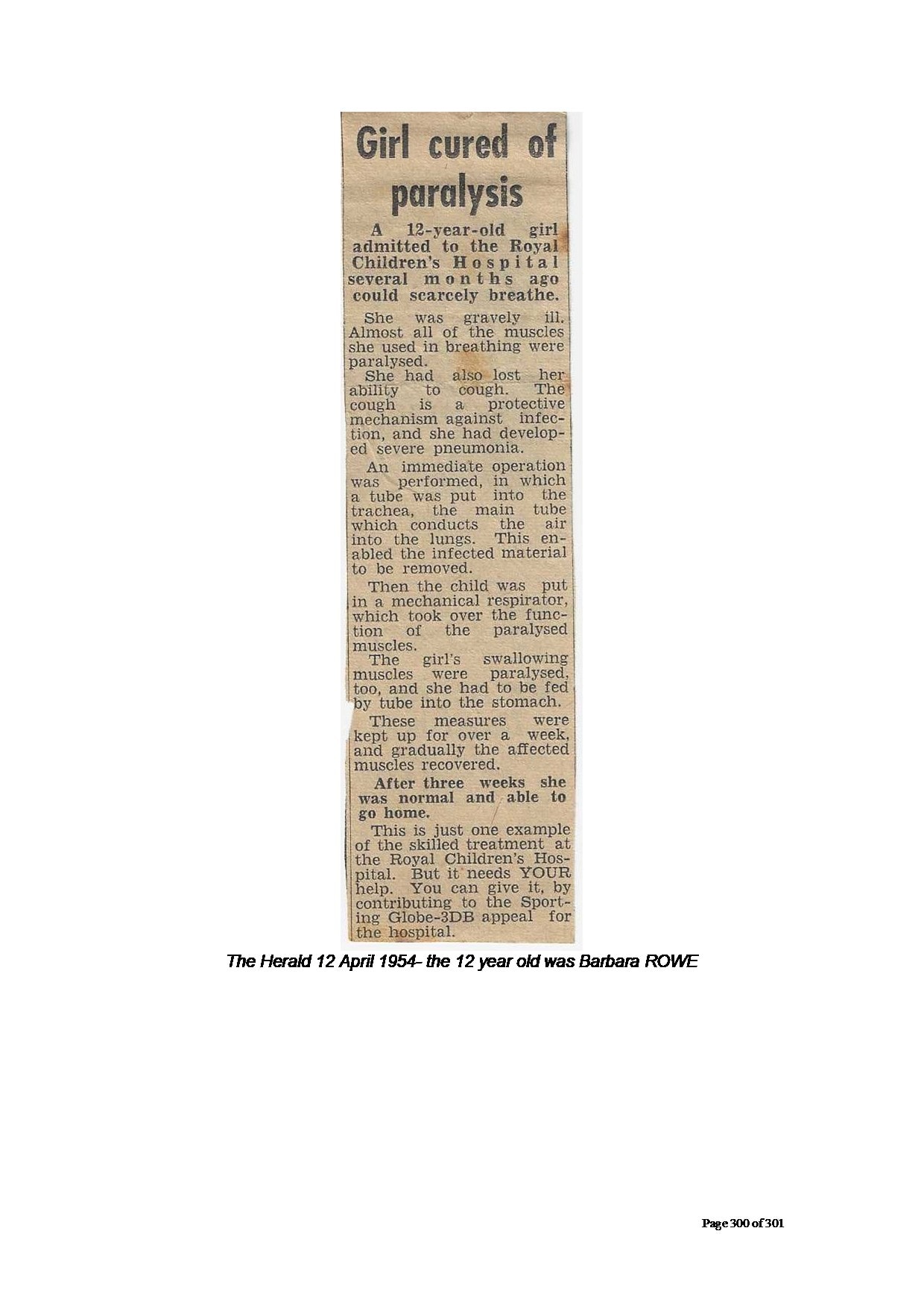
Barbara Rowe — The Girl Who Beat Polio
In 1953, Barbara Rowe — daughter of Leonard and Lilian (Lil) Rowe, née Webber — contracted polio. The Melbourne Herald ran her story in 1954 under the headline about a girl cured of paralysis. Barbara's recovery was remarkable enough to attract press attention at a time when polio was one of Australia's most feared diseases, before the Salk vaccine became available in 1956. Her mother Lil was the daughter of Benjamin Arthur and Jessie Webber. Barbara's baptismal certificate from 1942 is held by the family, as are photographs of her as a child in the garden with her brother Rod, and a later family portrait showing the Rowe family in the 1970s.
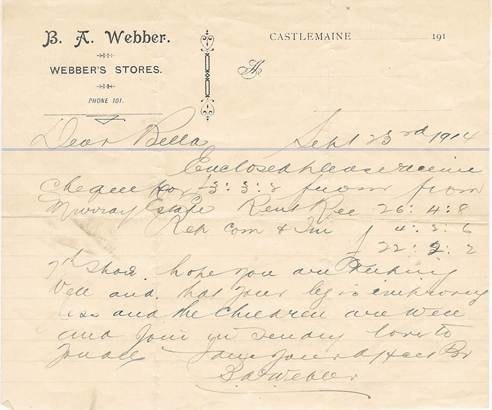
Bella Agel's Letters — Eleven Years of News from Castlemaine to Nottingham
Between 1911 and 1920, Benjamin Arthur Webber wrote eleven letters to his sister Bella Agel in Nottingham, England. Bella had married a man named Agel and moved to England; BA stayed in Castlemaine running the Brighton Hotel and later the Webber Stores. The letters are a remarkable social document: BA reports on cricket, the weather, the price of goods, the health of family members, and the progress of the war. In 1920 he writes of Winnie Bradbury's sudden death from diphtheria: 'it was a sad affair and so sudden, a terrible thing.' The eleven original letters, spanning 1911 to 1920, are preserved by the family and have been photographed for this archive.